
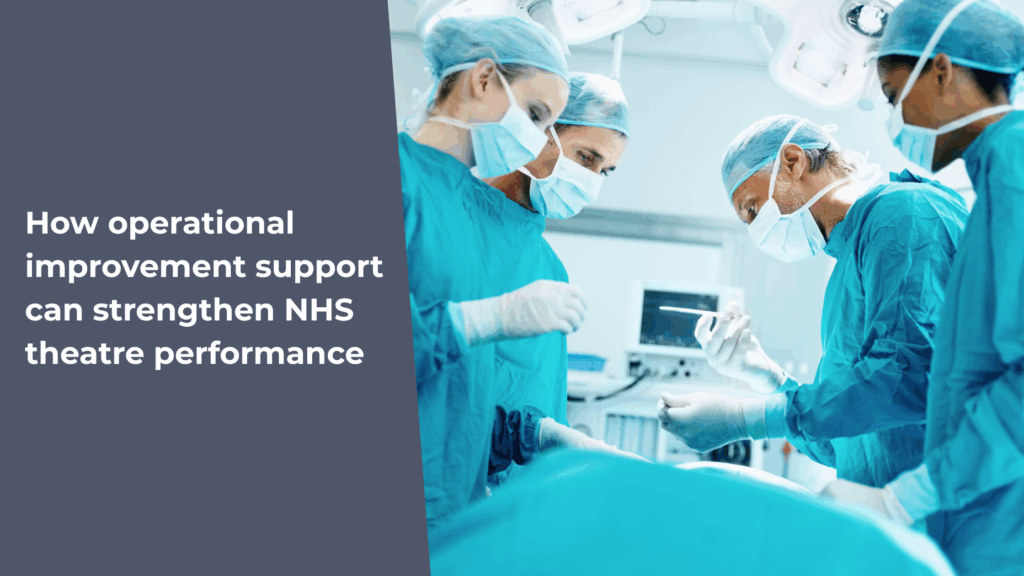
Hospital theatres remain one of the most resource‑intensive and strategically important parts of the NHS. They are central to recovering elective care, reducing waiting times, and ensuring patients receive timely, safe treatment. But they are also complex environments, dependent on smooth coordination across pre‑operative processes, workforce availability, scheduling, bed flow, equipment readiness and daily operational rhythm.
Dr Foster data illustrates just how stretched the elective system has become. Mean average waits for elective procedures range from 25 to 381 days*, depending on the specialty and complexity of care, highlighting extremely wide variation and significant demand pressure.
According to the NHS, the number of RTT pathways at the end of January 2026 was 7.2 million. Interestingly, plastic surgery has 3.3% of all their patients waiting more than 52 weeks, equating to 3549 patients – with children waiting even longer.
When upstream waits stretch this far, operational excellence inside theatres becomes even more essential to maintaining patient flow and avoiding further delays.
Even when theatre teams are highly skilled and committed, persistent structural challenges can limit productivity: late starts, variation between lists, dropped sessions, last‑minute cancellations, workforce gaps, or inconsistent governance. Many Trusts are already working hard on these issues, but additional operational and analytical support can help accelerate progress.
This blog explores how structured improvement support can strengthen NHS theatre performance and integrates anonymised case insights to illustrate what the process can look like in practice.
Understanding the root causes behind theatre underperformance
A key first step in any theatre improvement programme is a thorough insight and discovery phase. This combines observational work, staff engagement and detailed data analysis. Teams explore questions such as:
- Where are the most common delays occurring?
- How consistent is list utilisation across consultants and specialties?
- Are job plans aligned with actual clinical activity?
- How effectively are pre‑assessment, scheduling and booking processes working?
- What proportion of sessions are dropped, and why?
These questions take on even greater relevance when considering national variation. In orthopaedics, for example, the mean wait time is 150 days, with a range between 32 and 232 days*, showing wide variation in pathways and flow that ultimately affects theatre throughput.
Improvement specialists typically triangulate staff insights with activity and utilisation data to identify realistic levers for change. This ensures that any interventions are grounded in the day‑to‑day reality of the theatre environment, rather than abstract modelling.
Case insight one: diagnosing the data foundations
In one NHS theatre programme that we undertook with Four Eyes Insight, an early focus was placed on resetting baseline analytics. This involved reviewing utilisation, baseline KPIs, and specialty level performance trends.
This process helped identify avoidable variation in late starts and inter‑case downtime, alongside governance gaps in list validation and escalation processes. Teams then worked together to define meaningful KPIs, set expectations, and agree a new structure for regular review.
This mirrors national findings that highlight inconsistency in pre‑operative pathways: 429,505 patients nationally stayed longer than one day* for procedures expected to be day cases, prompting questions around pathway design, complications management, or discharge efficiency. Understanding these contextual patterns helps Trusts sharpen their local diagnostic work.
Turning insight into practical, staff‑led change
Once themes are identified, improvement efforts shift to collaborative, practical change. These are typically areas such as:
- Strengthening pre‑assessment and booking processes
Many last‑minute cancellations can be traced back to inconsistent pre‑assessment or unclear clinical ownership. Given that pre‑operative LOS varies significantly across the system, with many days likely avoidable, strengthening these pathways is essential to preventing wasted theatre time and reducing pressure on beds.
Programmes often help clarify these pathways, embed standardised SOPs, and better align capacity with expected elective demand.
- Optimising scheduling and the construction of theatre lists
Data modelling supports “what if?” scenario testing – adjusted list durations, case mix rebalancing, tighter alignment of job plans, or introducing standby patients.
This is especially valuable when national analytics show that if Trusts reduced just 50% of excess bed days, they could free 634,540 bed days or save approximately £183m* – capacity that would directly support smoother theatre scheduling and improved elective flow.
- Improving theatre timetabling, leave management and governance
Dropped sessions often relate to workforce gaps, late notice leave, or misaligned timetables. Trusts that introduce stronger 6‑4‑2 governance and daily huddles frequently see improved forward planning and fewer wasted sessions.
- Strengthening operational grip on the day
Small improvements such as clearer roles, better escalation processes, or more structured daily huddles can make a significant difference to throughput and patient flow.
Case insight two: improving the basics to strengthen daily performance
A hospital undertaking a 20‑week theatre improvement programme identified early challenges around dropped sessions, on‑the‑day cancellations and variable governance. By reinforcing “Firm Foundation” processes, including daily huddles, refreshed escalation processes, and a revised governance structure, teams achieved the following:
- A modest increase in average cases per session (ACPS) from around 1.6 to 1.7
- Improved utilisation rising from approximately 78% to over 80%
- Reduced downtime between cases through better staffing models and preparation routines
- More consistent role clarity and a new Theatre Improvement Group to maintain accountability
These gains were achieved not through major service redesign, but by refocusing attention on day‑to‑day basics and strengthening communication.
Case insight three: reducing dropped sessions through better planning
In another setting, a detailed review of dropped sessions revealed gaps in how theatre space was allocated and managed. Mapping specialty uses across an annual cycle helped the team understand where shortfalls were occurring.
Key improvements included the following:
- Relaunching structured 6‑4‑2 governance
- Reassessing workforce alignment with funded sessions
- Introducing clearer booking rules and escalation processes
- Using capacity modelling to guide reallocation of procedures to underused sessions
As a result, dropped sessions reduced by around 20–25%, and weekly delivered sessions increased modestly.
Case insight four: testing new models: high‑performance and parallel lists
Some hospitals tested new listing models, often called High‑Performance Lists (HPLs) or Parallel Lists, to demonstrate what could be achieved in a more optimised workflow.
Across a range of specialties, these test‑of‑change pilots delivered:
- Substantial increases in ACPS (e.g., doubling for some specialties in proof‑of‑concept trials)
- Reduced changeover times, sometimes by more than half
- Higher utilisation, in some cases above 100% where workflow efficiencies allowed additional cases
These results were not achieved by pushing staff harder but by redesigning the sequence of tasks, ensuring better preparedness, and tightening operational handover processes.
Importantly, programmes emphasised clinical safety and staff confidence. Introducing HPLs gradually and developing SOPs and toolkits to allow teams to embed the approach at their own pace.
Case insight five: elective hub improvements achieved through consistent governance
At an elective surgical hub, a structured improvement programme focusing on both foundations and advanced listing models led to:
- An increase from around 185 to over 190 completed cases per week
- Notable improvements across breast, ENT, general surgery and gynaecology services
- Reduced opportunity (i.e., wasted time) across multiple specialties
- More consistent “touch time” utilisation
- A daily SitRep enabling live operational oversight
This combination of standardised reporting, clearer accountability, and enhanced booking governance resulted in more predictable performance and reduced unwarranted variation across specialties.
Sustaining Improvements Through Capability Building
A key part of improvement support is ensuring the Trust continues to progress once the external support ends. This typically involves:
- Developing SOPs and governance artefacts
- Creating handover packs and training super‑users
- Embedding dashboards and KPI monitoring
- Upskilling operational, nursing and medical staff
- Identifying internal “change champions” to maintain momentum
This emphasis on sustainability helps ensure improvements persist long after the programme has concluded.
Final Thoughts
Theatres are one of the most powerful levers for elective recovery. But the national data is clear: variation in waiting times, LOS, day‑case delivery, and excess bed‑day usage is placing unprecedented pressure on the system.
By combining structured operational support with theatre‑level analytics, Trusts can:
- Strengthen the basics
- Unlock hidden capacity
- Reduce unwarranted variation
- Improve daily operational grip
- Deliver more predictable elective flow
With the right support, NHS organisations can build more resilient and productive theatre services – supporting better patient flow, reduced waits, and a more sustainable system for the long term.
* Data taken from Dr Foster. Assuming that the data is truly reflective of the activity on the ground.
Click here to learn more about how our theatre programmes have supported the NHS.
Click here to learn more about Four Eyes Insight.
Click here to learn more about Dr Foster.
© Copyright PRISM IMPROVEMENT 2021 | Designed by ODYSSEY STUDIO