
Improving patient flow is a critical challenge for NHS Trusts across the UK. At a North West NHS Trust, the Urgent & Emergency Care (UEC) Improvement Programme has delivered measurable success by focusing on reducing the number of days patients spend away from home. This case study explores how targeted interventions led to significant improvements in patient care and operational efficiency.
Click here to download the full case study.
Programme Objectives
The Trust partnered with Prism Improvement to implement changes under the Reducing Days Away from Home workstream. The goal: support timely discharge and reduce unnecessary inpatient stays, helping the Trust meet the 4-hour emergency access standard.
Four High-Impact Projects Driving Change
Criteria to Reside (CTR) Implementation
- Training delivered to 9 of 20 wards.
- CTR compliance improved: patients without CTR recorded dropped from 100 (Dec 2024) to 3 (Apr 2025).
- Next step: full rollout across all wards using the established training model.
Length of Stay (LOS) Reviews
- Weekly LOS meetings introduced for medical and surgical wards.
- Focus: patients with LOS > 7 days.
- Impact: LOS reduced from 10.1 days (Jan) to 8.56 days (Mar).
Managing Outliers
- Daily outlier list created and owned by the site team.
- Improved safety and tracking of patient placement.
- Digital solutions explored to support accuracy and efficiency.
Weekend Discharge Planning
- Friday senior walkarounds introduced.
- Weekend discharge task list implemented.
- Results: Weekend discharges rose from 48 (Jan) to an average of 64 (Mar–Apr), peaking at 70.
Key Outcomes
- LOS Reduction: 0.79-day decrease across pilot wards.
- CTR Compliance: Near-universal recording achieved.
- Weekend Discharges: Significant increase in discharge activity.
- Outlier Management: Safer, more efficient patient placement.
Sustainability & Recommendations
To maintain and build on these improvements, the Trust is advised to:
- Continue CTR rollout across all wards.
- Enhance digital systems for ward-level data access.
- Expand outlier management principles to AMU.
- Embed successful initiatives into business-as-usual operations.
Final Thoughts
This case study highlights how focused, collaborative improvement efforts can lead to tangible benefits in urgent and emergency care. By combining training, governance, digital tools, and frontline engagement, the Trust has made strides in improving patient outcomes and operational performance.
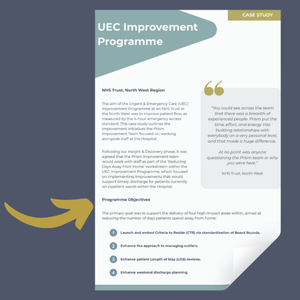
Click the image to download the more detailed case study ⬇️
Want to learn more?
Cick the link below to contact us ⬇️