
Why Endoscopy Capacity Has Become a Defining Test for the NHS
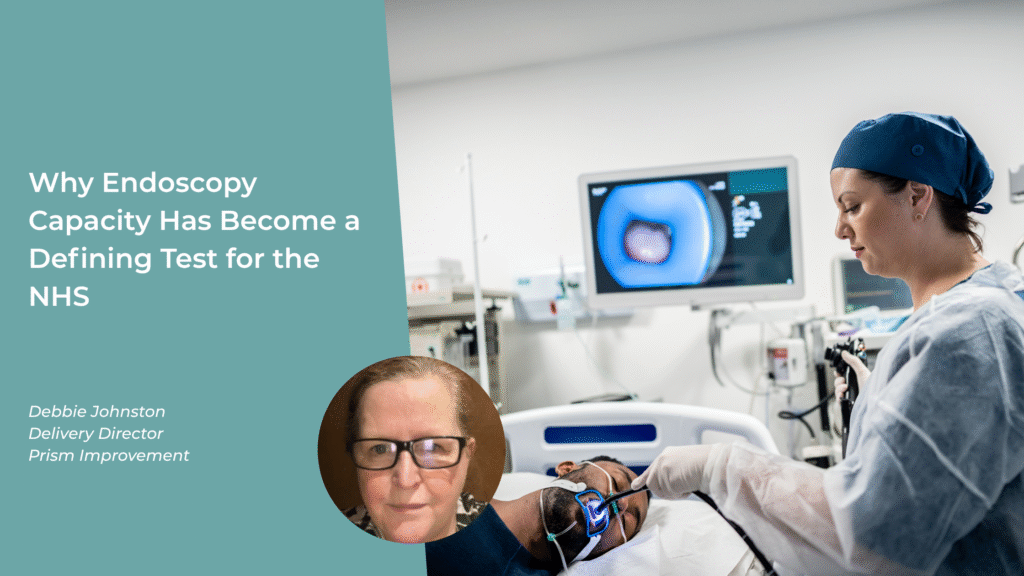
Few diagnostic services sit at as sharp an intersection of patient safety, cancer outcomes, and operational pressure as endoscopy. It is the gateway test for suspected bowel, oesophageal, and stomach cancer, the backbone of the national bowel cancer screening programme, and one of the busiest diagnostic specialties in any hospital.
When endoscopy services stretch, the consequences are felt all the way along the patient pathway – from a GP referral to a cancer diagnosis or treatment.
The scale of the challenge
The pressure on diagnostics has been building for years, and endoscopy is on the front line of it. By the middle of 2025, in England, around one in five patients on the diagnostic waiting list, a list that includes endoscopy alongside imaging and physiological measurement tests, had been waiting more than six weeks, against an operational standard that only 1% should wait that long. Progress against post-pandemic recovery targets has been slower than planned, and diagnostics have not always had the same visibility in national planning as elective treatment waits, even though delayed diagnostic tests carry their own clinical risk.
At the same time, demand is rising rather than easing. The NHS bowel cancer screening programme is moving towards a lower FIT (faecal immunochemical test) threshold and a wider eligible age range, with national ambitions to deliver around a third more screening colonoscopies by 2028. Community Diagnostic Centres – the “one-stop shop” model rolled out to relieve pressure on hospital sites – delivered well over 8.7 million tests, checks, and scans (including endoscopy procedures) in a single year, a sign of both the scale of investment and the scale of underlying demand. Independent sector data tells a similar story, with lower gastrointestinal endoscopy procedure volumes climbing by over a fifth in the last few years as more activity is pushed beyond core NHS capacity.
Why this matters beyond the waiting list number
It’s tempting to read endoscopy performance purely as a waiting-times statistic. In practice, it’s a proxy for something more fundamental: how reliably a hospital can convert a referral into a timely, safe, well-coordinated patient pathway. Behind every “6+ week wait” figure sits a chain of decisions – list utilisation, pre-assessment efficiency, workforce planning, governance and oversight – each of which either protects or erodes patient flow.
This is also where quality assurance becomes inseparable from capacity. JAG accreditation, run by the Joint Advisory Group on Gastrointestinal Endoscopy, is the recognised UK and Ireland benchmark for endoscopy service quality, safety, and workforce standards. The majority of UK endoscopy services are now actively engaged in the JAG accreditation pathway, with well over 190 holding full accreditation. It’s a useful reminder that “more capacity” and “safe, accredited capacity” are not always the same thing – and that any improvement programme needs to protect, not dilute, clinical governance.
A pattern worth recognising
Trusts that have made the most headway tend to share a common thread: they treat productivity, patient flow, and governance as one connected system rather than three separate problems. We’ve seen this play out directly in our work with The Shrewsbury and Telford Hospital NHS Trust, where a structured Endoscopy Improvement Programme addressed productivity, performance visibility, and patient pathway coordination together, with measurable results across operational performance, patient experience, and workforce sustainability.
Over the next two articles in this series, we’ll look more closely at what that kind of structured improvement actually involves and what it took for one trust to turn rising demand and insourcing reliance into a more stable, self-sufficient service.
Sources referenced: NHS England diagnostic waiting times commentary (National Audit Office/Public Accounts Committee report, 2025–26); Cancer Research UK on NHS bowel screening threshold changes (2026); GOV.UK Community Diagnostic Centres data; PHIN bowel cancer private healthcare data (2026); Royal College of Physicians JAG accreditation standards announcement.

About Debbie Johnston
With a background in consulting, management, and professional services in both the public and private sectors, Debbie brings a results-driven approach to her role as delivery director. With a track record of impressive leadership in endoscopy quality assurance and improvement, Debbie is dedicated to making strides in healthcare service quality and efficiency.
In addition to her responsibilities as Delivery Director, Debbie has extensive experience as an Expert Endoscopy Improvement Advisor for the Republic of Ireland and is Head Assessor for the Joint Advisory Group (JAG) quality assurance scheme. Delivering workshops in Canada and generating notable gains in acute NHS Trusts, Debbie has guided organisations to improve the planning, productivity, and efficiency of endoscopy services.

© Copyright PRISM IMPROVEMENT 2021 | Designed by ODYSSEY STUDIO